
Did Mozart Have Children?
You might be curious if Mozart had children, and he did—six in total with his wife, Constanze. Sadly, only two survived past infancy, and neither had children, so his family line ended there.
Despite this tragedy, Mozart found personal joy in marriage and fatherhood amid hardships. If you want to uncover how these experiences shaped his life and legacy, there’s more to explore beyond just these facts.
Key Takeaways
- Mozart married Constanze Weber in 1782 and had six children with her. Only two of Mozart’s children, Karl Thomas and Franz Xaver Wolfgang, survived infancy.
- The other four children died young due to illnesses common in the 18th century. Sadly, this was quite common back then.
- None of Mozart’s surviving children had offspring, ending his direct family line. So, there are no direct descendants of Mozart today.
- But Mozart’s legacy lives on through his incredible music, not through descendants. His work continues to inspire people all over the world.
Mozart’s Family Life and Marriage

Although Mozart is best known for his music, his family life played a significant role in his personal story. Wolfgang Amadeus Mozart married Constanze Weber in 1782 when he was 26 years old. Their marriage marked a meaningful chapter in Mozart’s life beyond composition.
Together, Mozart and his wife had six children, but only two survived infancy: Karl Thomas Mozart, born in 1784, and Franz Xaver Wolfgang Mozart, born in 1791. The rest of Mozart’s children tragically died in early childhood, reflecting the harsh realities of 18th-century illnesses.
Despite these losses, Mozart’s family life with Constanze remained central to him. You’ll find that understanding Mozart’s marriage and his surviving children gives insight into his personal world amid his legendary musical career.
The Fate of Mozart’s Children
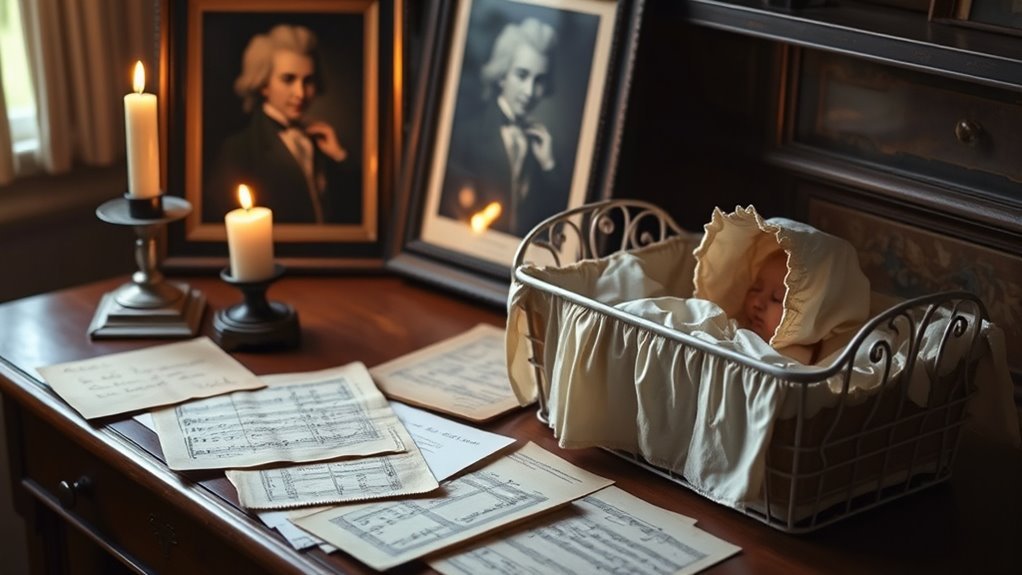
Mozart’s family life was marked by both joy and heartbreak, as you can see when you look at the fate of his children. Of six Mozart children, only two survived infancy: Karl Thomas Mozart and Franz Xaver Wolfgang.
Sadly, the rest, including Raimund Leopold, Johann Thomas Leopold, and Theresia, died in early childhood due to disease. It’s really tragic when you think about it.
Despite their talents and efforts, neither surviving child had offspring, leading to a childless end of the Mozart family line. So, the family name didn’t continue.
Here’s the fate of Mozart’s children at a glance:
- Raimund Leopold, Johann Thomas Leopold, and others died young
- Karl Thomas Mozart worked as accountant and translator, no descendants
- Franz Xaver Wolfgang pursued music but died childless
- Mozart family line ended with no direct descendants
You see, Mozart’s legacy lives on only through his music, not descendants. It’s music that keeps his memory alive, not family.
Frequently Asked Questions
What Happened to Mozart’s Wife and Children?
Mozart’s wife, Constanze, outlived him and raised their surviving sons, Karl and Franz. Sadly, their other children died young.
Neither son had children, so Mozart’s direct family line ended with them. It’s kind of bittersweet when you think about it—his legacy lives on through his music, but not through descendants.
Why Did Mozart’s Wife Not Attend His Funeral?
You wouldn’t find Constanze at Mozart’s funeral because she was too overwhelmed with grief and illness. She couldn’t attend due to her fragile health, not because she chose to skip it—she stayed devoted to his memory.
It wasn’t a matter of neglect or distance. Instead, her condition simply made it impossible for her to be there. Despite that, her love and dedication to Mozart never wavered.
Are There Any Mozart Descendants Alive Today?
You won’t find a “little Mozart” today—his family line ended long ago.
Though his melodies still dance through time, none of his children had heirs, so no direct descendants of Mozart are alive now.
Did Mozart Have Asperger’s Syndrome?
You can’t say Mozart had Asperger’s for sure since it wasn’t diagnosed back then. Some traits match, like his focus and social quirks, but without solid evidence, it’s just speculation, not a confirmed fact.
It’s interesting to think about, though. People often look at historical figures through the lens of modern science, but we have to be careful not to jump to conclusions.
Conclusion
You might expect a musical genius like Mozart to have a big, thriving family, right? Well, ironically, despite his marriage and several children, most didn’t survive past infancy.
It’s almost like his incredible talent for composing didn’t quite extend to keeping his family alive. So, while his music lives on forever, his children sadly didn’t get the same lasting legacy.
Life sure has a strange sense of irony, doesn’t it? Mozart’s legacy is defined by his timeless compositions rather than a large family line. Even though he did have children, the harsh reality was that most of them didn’t survive. This contrast between his enduring musical genius and the fragility of his family life highlights the poignant and bittersweet aspects of Mozart’s story.